From Section 5.2, accretion of positive energy does not decrease \(J\); the registered \(J\) can decrease in three ways: by re-registration (\(N\) unchanged, the difference held temporarily by the field and carried off by radiation; Section 4.6), by reducing the number of capsules, or by breaking.
(1) Spin-down in evaporation. In semiclassical calculations, a rotating black hole radiates angular momentum several times faster than energy, and a rapidly rotating black hole spins down to near zero before losing most of its mass [8, 27]; in the summary of Taylor, Chambers and Hiscock [28], the spin is already close to zero when about half the mass has been lost. These semiclassical results apply at large \(N\); for small \(N\) the framework reaches the same conclusion (Section 4.6). In this framework what is emitted is always an irreducible capsule; a rotational capsule must first be re-registered as an irreducible capsule and is then emitted. Following Page’s results, angular momentum is lost first, which corresponds to frequent re-registration during emission, and the framework is compatible with this. Re-registered capsules are ordered by the temperature at registration; by last in, first out, the last pack registered on the outer horizon is the first to be emitted. The whole-pack counting inside is not visible from outside; only the sub-steps are. Each emitted pack is seen as \(2N-1\) sub-step quanta, which together carry away energy \(E_P\) and angular momentum \(L\), so the externally observable change of angular momentum proceeds in units of sub-steps (Section 3.6). Since \(L\) accumulates from the sub-steps and need not equal the whole-pack registered value exactly, the difference is held temporarily in the field, and on average this gives the probabilistic rule of Eq. (55). By Section 5.1, the angular-momentum difference is held temporarily by the field, so the emitted quanta need not carry away all the angular momentum of that capsule within one pack; the spin decreases continuously, consistent with Page’s results. For comparison, if the angular momentum carried away by each emitted pack is taken to be the value \(L_{in}\) brought in by accretion (Eq. (53)), evaporation retraces the accretion path. From Eq. (57), integrating from the initial spin \(\chi_0\) to zero angular momentum,
where \(\tilde l\) and \(\tilde e\) vary with \(\chi\) according to Eqs. (50) and (51), and the integral is evaluated numerically. The value 0.49 is close to Page’s result (about 0.50). As \(\chi_0\to1\) the integral converges to \(-\ln\sqrt6\) and \(N/N_0=1/\sqrt6\approx0.41\). This is exactly the reverse of accretion: spinning a non-rotating black hole up to the extremal state by thin-disk accretion requires the mass to grow by a factor \(\sqrt6\), in agreement with Bardeen’s analytic result [5]. Along this path the proportion of emissions accompanied by re-registration is far above the share of rotational capsules in the black hole: about 2.4 times at the start, rising as the spin falls to more than a hundred times in the low-spin stage, so the angular momentum reaches zero before the mass does. Real evaporation is irreversible and follows Page’s path.
(2) A rotational capsule is first re-registered, then emitted (\(N_{rot}\to N_{irr}\)). A rotational capsule that is first re-registered and then emitted as an irreducible capsule reaches the same final state as directly emitting a rotational pack: \(N_{irr}\) is unchanged, the outer-horizon area first increases and then decreases with no net change, and the angular momentum carried out is the registered value \(\Delta J_{rot}\) of a rotational pack. Its ratio to the energy: from Eq. (48), \(\Delta J_{rot}\simeq2N\hbar\cot\omega\); using \(\hbar/E_P=\ell_p/c\),
The horizon angular velocity \(\Omega_H\) is the angular velocity with which the outer horizon rotates with the black hole; the Kerr solution gives \(\Omega_H=ac/(r_+^2+a^2)\) [29]. Using \(r_+^2+a^2=R_sr_+\), \(a=(R_s/2)\sin2\omega\) and \(r_+=(R_s/2)(1+\cos2\omega)\) (Paper II [10]):
so
That is, when a rotational capsule is re-registered once and then emitted, the ratio of the angular momentum carried out to the energy is exactly \(1/\Omega_H\).
Introducing the effective moment of inertia \(I\equiv J/\Omega_H\), Eq. (42), Eq. (60) and \(\tan\omega=k/N_{irr}\) give \(I=4\hbar NN_{irr}^2\ell_p/c\); with \(\hbar/c=m_P\ell_p\), \(I=4NN_{irr}^2m_P\ell_p^2=MR_{A+}^2\), as for a thin ring of mass \(M\) at the outer-horizon areal radius \(R_{A+}\). It is fixed by \(N\) and \(N_{irr}\) and is not a new variable. Eq. (61) can therefore be read as follows: for the same pack of energy \(E_P\), the larger the moment of inertia, i.e. the smaller \(\Omega_H=J/I\), the more angular momentum is registered. The angular momentum actually carried out is decided by the radiation and need not equal \(\Delta J_{rot}\). Suppose that for each pack emitted the energy is \(E_P\) and the angular momentum actually carried out is \(L\) (taken positive), i.e. \(\Delta(Mc^2)=-E_P\) and \(\Delta J=-L\). From the first law \(d(Mc^2)=T\,dS_++\Omega_H\,dJ\) (\(S_+\) the entropy of the outer horizon, \(T\) the Hawking temperature):
where the last step uses \(E_P/\Omega_H=\Delta J_{rot}\) from Eq. (61). \(T\) and \(\Omega_H\) are both positive, so the sign of \(\Delta S_+\) depends only on the difference between the angular momentum \(L\) actually carried out and the registered value \(\Delta J_{rot}\) of a rotational pack; \(S_+\) is proportional to the outer-horizon area, and \(S_+=4\pi k_BN_{irr}^2\). Each pack emitted is completed through sub-steps, and \(N\) is unchanged while the sub-step quanta are being released. Eq. (62) takes representative values of \(T\) and \(\Omega_H\) over one pack and is a large-\(N\) first-order approximation: one pack changes them by a relative amount \(O(1/N)\), giving an error of \(O(\hbar)\), whereas \(L-\Delta J_{rot}\) is itself \(O(N\hbar)\); so the sign of \(\Delta S_+\) is affected only for \(\chi\) within \(O(1/N)\) of \(\chi_c\), which is negligible at large \(N\). A strict treatment would integrate \(T\,dS_++\Omega_H\,dJ\) along the path. Near the upper limit the temperature is very low and its relative change within one pack becomes larger, so the approximation should not be extrapolated to the vicinity of the limit.
The number of re-registrations corresponding to each pack of energy emitted is denoted \(m\); \(m\) is not decided in advance but results from re-registering pack by pack at the pace at which the angular-momentum difference is cleared. In the large-\(N\) first-order approximation each re-registration reduces the angular momentum by the same amount, so with \(m\) re-registrations during the emission of one pack the angular momentum carried out is \(\Delta J_{irr}+m(\Delta J_{rot}-\Delta J_{irr})\); \(m=0\) and \(1\) give \(\Delta J_{irr}\) and \(\Delta J_{rot}\) respectively. Its average is set equal to \(L\), i.e. \(\Delta J_{irr}+\bar m(\Delta J_{rot}-\Delta J_{irr})=L\). One re-registration increases the outer-horizon entropy by \(\Delta S_{re}=4\pi k_B(2N_{irr}+1)\simeq8\pi k_BN_{irr}\); in a direct emission the outer-horizon entropy decreases by about the same amount, so Eq. (62) gives \(\Delta J_{rot}-\Delta J_{irr}=T\Delta S_{re}/\Omega_H\). Further, from \(\Delta J_{rot}=E_P/\Omega_H\) in Eq. (61) and from Eq. (8), with \(N_{irr}=N\cos\omega\), \(T\Delta S_{re}\simeq E_P\cos2\omega/\cos\omega\). The average number of re-registrations is therefore
where \(\cos2\omega=\sqrt{1-\chi^2}\). Eqs. (62) and (63) give one and the same criterion: the comparison of \(L/E_P\) with \(1/\Omega_H\), i.e. of \(L\) with \(\Delta J_{rot}\); \(\Delta S_+\) and \(\bar m-1\) have the same sign. There are three cases:
\(L<\Delta J_{rot}\): \(\Delta S_+<0\), \(\bar m<1\), and the outer-horizon area decreases; fewer than one re-registration occurs during the emission of one pack, \(\bar m\) is the probability of one re-registration, the same as the probabilistic rule of Section 5.4, and \(N_{irr}\) decreases.
\(L=\Delta J_{rot}\): \(\Delta S_+=0\), \(\bar m=1\), and the outer-horizon area has no net change. This is exactly one re-registration followed by emission: the re-registration increases \(S_+\) by \(4\pi k_B(2N_{irr}+1)\) and the emission decreases it by the same amount.
\(L>\Delta J_{rot}\): beyond the range of one re-registration (carried away by superradiant quanta, or through the Penrose process, with negative energy and negative angular momentum flowing into the horizon), \(\Delta S_+>0\), \(\bar m>1\), and the outer-horizon area increases on net, i.e. more than one re-registration occurs during the emission of one pack: the last pack re-registered is emitted first and the rest remain as irreducible capsules, so \(N_{irr}\) increases on net, consistent with Page’s conclusion [8].
\(1/\Omega_H\) is also the boundary of the superradiance condition \(\varpi=m_\varphi\Omega_H\) (\(\varpi\) the angular frequency of the radiation, \(m_\varphi\) the angular-momentum quantum number along the axis): superradiant quanta have \(m_\varphi\hbar/(\hbar\varpi)>1/\Omega_H\), so \(L/E_P>1/\Omega_H\) means that the radiation lies on average on the superradiant side; superradiance dominates at rapid rotation [8, 30].
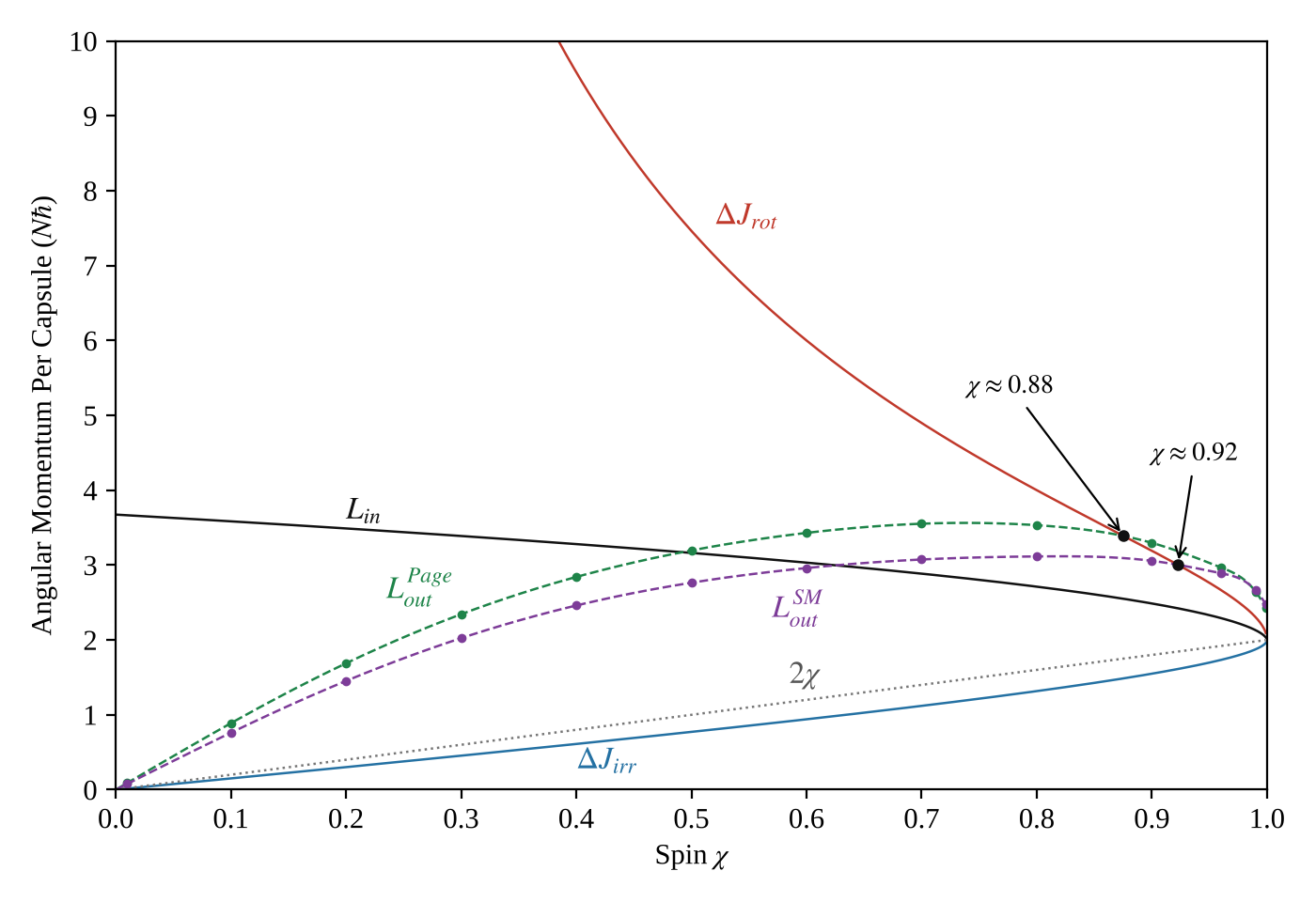
Quantitative comparison with Hawking radiation. Semiclassical calculations give the mass-loss rate and angular-momentum-loss rate of Hawking radiation from a rotating black hole, whose ratio varies with \(\chi\) [8]. From these we obtain \(L_{out}\), the angular momentum carried out by the radiation for each pack of energy \(E_P\) emitted. It is computed at each \(\chi\) from the emission rates of the various particles, using the data of Dong, Kinney and Stojkovic [31], and is plotted as dashed lines in Fig. 5. Two limits are taken: Page’s [8] photons, neutrinos and gravitons, applicable to low-temperature black holes that can emit only massless particles; and all Standard Model particles in the massless limit, applicable to high-temperature black holes with \(k_BT_H\gg100\) GeV. Real black holes lie between the two.
In Fig. 5 the grey dotted line is the baseline \(2\chi\) (Eq. (45)). The accretion \(L_{in}\) lies above it, i.e. Eq. (53), and the spin rises; the evaporation \(L_{out}\) also lies above it, and as mass decreases the spin falls, which is Page’s conclusion. \(L_{out}\) always lies above the baseline \(2\chi\), so in evaporation the spin only falls and the black hole evolves along the horizontal axis from right to left: for \(\chi>\chi_c\) the outer-horizon entropy increases on average per emitted pack, and after falling below \(\chi_c\) it decreases instead (Eq. (62)). As \(\chi\to0\), \(L_{out}\to0\): a non-rotating black hole emits no net angular momentum, in contrast with \(L_{in}\to3.67N\hbar\) for accretion. At low and intermediate spin \(L_{out}\) lies between \(\Delta J_{irr}\) and \(\Delta J_{rot}\), which is the case \(\bar m<1\) of Eq. (63), and recovers Page’s spin-down on average. When the spin exceeds \(\chi_c\) (about 0.88 for Page’s set, about 0.92 for the Standard Model), \(L_{out}>\Delta J_{rot}\): the angular momentum carried out per pack of energy emitted exceeds that carried out by one re-registration followed by emission. This crossing is insensitive to the particle species: as \(\chi\to1\), \(L_{out}\) in both limits tends to about \(2.4\)–\(2.5\,N\hbar\), whereas \(\Delta J_{rot}\to2N\hbar\).
The crossing does not contradict the framework; it is exactly the case \(L>\Delta J_{rot}\) above. From Eq. (62) with \(L=L_{out}\), \(T\,\Delta S_+=\Omega_H(L_{out}-\Delta J_{rot})\). So, in the radiation process, the intersection of \(L_{out}\) and \(\Delta J_{rot}\) is exactly the boundary at which the outer-horizon entropy \(S_+\) switches from increasing to decreasing, i.e. the location of the criterion \(L_{out}/E_P=1/\Omega_H\): for \(\chi>\chi_c\), \(S_+\) increases, and for \(\chi<\chi_c\) emission decreases \(S_+\), consistent with Page’s finding that the area of a rapidly rotating black hole first increases. Page [8] gave only the qualitative conclusion (for sufficiently rapid rotation the area and entropy first increase); by the first law, this threshold is the \(\chi_c\) solved for in this framework. The excess \(L_{out}-\Delta J_{rot}\) comes from the additional re-registrations during the emission of one pack (\(N\) unchanged, \(N_{irr}\) increasing, \(S_+\propto N_{irr}^2\) increasing): during the emission of one irreducible pack more than one re-registration occurs; for Page’s particle set, about 1.79 on average at \(\chi=0.99\). In this way the registration rules are compatible with Hawking radiation over the whole spin range; the value of \(\chi_c\) depends on the particle species, while the meaning of the intersection is fixed by the first law.
From the \(L_{out}\) data in Fig. 5, Eq. (63) gives the balance ratio \(\bar m\) between re-registration and emission at each spin, listed in Table 7. In the table, “Page” denotes photons, neutrinos and gravitons and “Standard Model” all Standard Model particles (massless limit); \(\chi_c\approx0.875\) for Page’s set and \(\chi_c\approx0.923\) for the Standard Model. For \(\bar m<1\) the ratio re-registered : emitted is written \(1:(1/\bar m)\), i.e. the number of packs emitted per pack re-registered. For \(\chi<\chi_c\) fewer packs are re-registered than emitted: each pack re-registered can be paired with one pack emitted, i.e. re-register one and emit one, and the rest are emitted directly, so \(N_{irr}\) decreases gradually; at \(\chi=\chi_c\) the two are equal; for \(\chi>\chi_c\) more packs are re-registered than emitted, and at certain moments an extra pack must be re-registered to make up the angular-momentum difference; the extra re-registered capsules remain as irreducible capsules, \(N_{irr}\) increases and the outer-horizon area grows. As \(\chi\to1\), \(\Delta J_{rot}-\Delta J_{irr}\) is very small and the ratio is very sensitive to \(L_{out}\); the row \(\chi=0.99\) shows only the trend.
| \(\chi\) | \(\bar m\) (Page) | Re-reg. : emit (Page) | \(\bar m\) (Standard Model) | Re-reg. : emit (Standard Model) |
|---|---|---|---|---|
| 0.1 | 0.02 | 1 : 54 | 0.02 | 1 : 65 |
| 0.3 | 0.15 | 1 : 6.7 | 0.12 | 1 : 8.0 |
| 0.5 | 0.36 | 1 : 2.8 | 0.30 | 1 : 3.4 |
| 0.7 | 0.64 | 1 : 1.6 | 0.52 | 1 : 1.9 |
| 0.8 | 0.83 | 1 : 1.2 | 0.67 | 1 : 1.5 |
| 0.875 | 1.00 | 1 : 1 | 0.84 | 1 : 1.2 |
| 0.9 | 1.06 | 1.06 : 1 | 0.92 | 1 : 1.1 |
| 0.923 | 1.13 | 1.13 : 1 | 1.00 | 1 : 1 |
| 0.95 | 1.25 | 1.25 : 1 | 1.15 | 1.15 : 1 |
| 0.98 | 1.57 | 1.57 : 1 | 1.54 | 1.54 : 1 |
| 0.99 | 1.79 | 1.79 : 1 | 1.83 | 1.83 : 1 |
(3) The Penrose process and superradiance. In general relativity, both let particles carrying negative energy and negative angular momentum fall into the black hole, thereby reducing \(M\) and \(J\) [21, 30]. In this framework every capsule has energy \(+E_P\), and there are no negative-energy capsules; the infall of negative-energy particles amounts to the black hole losing energy, of the same kind as evaporation, not accretion. When the energy lost is less than one pack \(E_P\), the registration appears as re-registration (\(N\) unchanged); only when it accumulates to one pack \(E_P\) is one capsule emitted.