Evaporation lifetime. The commonly used evaporation lifetime of a Schwarzschild black hole, \(t_{ev,\gamma}=5120\pi G^2M^3/(\hbar c^4)\), counts only photons and assumes blackbody radiation from the horizon surface; it applies only to large black holes with very low Hawking temperature. The temperature at which a small-\(N\) black hole emits a whole pack is given by Eq. (2), \(k_BT_N^{-}=E_P/[4\pi(2N-1)]\); this is the characteristic energy of the Hawking radiation, not the total energy \(NE_P\) of the black hole. Massless particles (photons, gluons, gravitons) are emitted at any temperature; massive particles are emitted copiously only when their rest energy is below about \(k_BT_N^{-}\) [14, 15]. For the last pack (\(N=2\to1\)), \(k_BT_2^{-}=E_P/(12\pi)\approx3.2\times10^{17}\) GeV (\(T_2^{-}\approx3.8\times10^{30}\) K), far above the top quark (about 173 GeV), which has the highest rest energy among the elementary particles of the Standard Model; so all Standard Model particles are emitted, and all at ultra-relativistic speeds:
The curved spacetime outside a black hole reflects part of the low-energy quanta back, so both absorption and emission are less than for a blackbody; this is called a greybody. On the basis of the greybody calculation of MacGibbon and Webber [14] for all Standard Model particles, Carr et al. [16, 17] give the accurate evaporation lifetime
where \(M\) is in kg and \(t_{ev,grey}\) in s; \(f_{ev}\) is the weight of the emitted particle species: \(f_{ev}=1\) when only massless particles (photons, three generations of neutrinos, gravitons) are emitted, and \(f_{ev}=15.35\) when all Standard Model particles are included. For small-\(N\) black holes we take \(f_{ev}=15.35\) and substitute \(M=Nm_P\) (\(m_P=2.176\times10^{-8}\) kg):
With \(t_P=5.391\times10^{-44}\) s, \(t_{ev,grey}\approx3.4\times10^{-41}\) s for \(N=2\), \(t_{ev,grey}\approx5.2\times10^{-40}\) s for \(N=5\), and \(t_{ev,grey}\approx1.4\times10^{-39}\) s for \(N=7\). Counting only photons, the coefficient is \(5120\pi\approx16085\) and the lifetime is about 207 times longer. For \(N=2\)–7 this is an estimate obtained by extrapolating the semiclassical formula to the Planck scale. \(f_{ev}=15.35\) counts particles only up to about \(10^3\) GeV; if many more species exist at higher energies, the lifetime is shorter still.
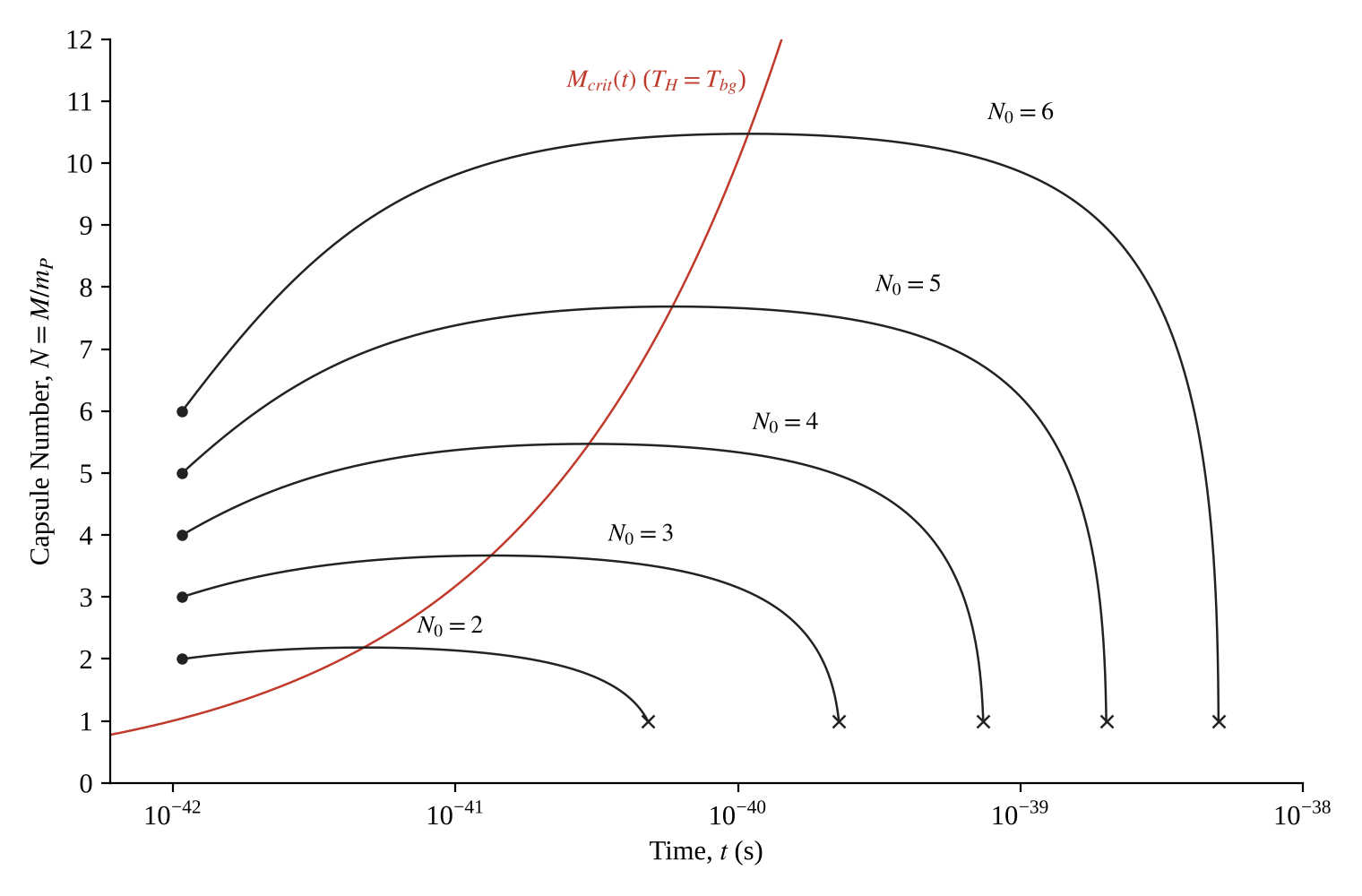
Growth and evaporation of black holes in the early universe. Small-\(N\) black holes form in the early universe and absorb on net while the background temperature \(T_{bg}\) is above \(T_H\). Figure 2 integrates the net change of black-hole mass: absorption of background radiation and emission of Hawking radiation use the same cross-section, so the net change vanishes exactly at \(T_H=T_{bg}\), i.e. at the critical mass \(M_{crit}(t)\); the cross-section is taken as 0.574 times the geometric-optics value so that the emission-only lifetime agrees with Eq. (40): with emission only, the black-body lifetime is \(40960\pi N^3t_P/(27sg_*)\); setting it equal to the \(77.8N^3t_P\) of Eq. (40) with \(g_*=106.75\) gives \(s=40960\pi/(27\times106.75\times77.8)\approx0.574\). Black holes with \(N_0=2\)–6 all form at \(t_0=20\,t_P\), and growth by accretion is capped at three times the initial mass (not reached in this figure). Each black hole first grows and, once overtaken by \(M_{crit}(t)\), turns to net evaporation. For initial \(N_0=2\), 3, 4, 5, 6, \(N\) grows at most to about 2.2, 3.7, 5.5, 7.7 and 10.5 respectively, and the black holes evaporate completely at about \(4.8\times10^{-41}\), \(2.3\times10^{-40}\), \(7.4\times10^{-40}\), \(2.0\times10^{-39}\) and \(5.0\times10^{-39}\) s. In this framework energy enters and leaves in whole packs of \(E_P\), and the continuous curves represent average behaviour. Counting in whole packs, \(N_0=2\) and 3 absorb less than one full pack, cannot grow to the next level, and evaporate directly last in, first out; \(N_0=4\) can grow to 5, the first stable structure; \(N_0=5\) and 6 can grow to 7 and 10 respectively. This does not contradict Eq. (33): the step-by-step growth of Eq. (33) requires a pack-forming supply near the contact density (Section 4.4), whereas Fig. 2 counts only absorption of background radiation; with background radiation alone, \(N=2\) and 3 cannot grow along Eq. (33).
Loss of angular momentum in evaporation. When a rotating small-\(N\) black hole evaporates, what is emitted is always an irreducible capsule; a rotational capsule must first be re-registered as an irreducible capsule and is then emitted (Section 5.1). The two rules operate in parallel: re-registration before emission prescribes how a capsule is emitted, and the existence criterion decides whether the black-hole state after each registration is allowed; re-registration increases the separation, so the intermediate state always satisfies the criterion, and the criterion forbids the direct emission of an irreducible capsule only when the separation is close to the lower limit, in which case the state must first be re-registered. There are two possibilities: a rotational capsule is first re-registered and then emitted, \(BH(N,N_{irr})\to BH(N-1,N_{irr})\), with intermediate state \(BH(N,N_{irr}+1)\) and the same final state as emitting a rotational pack; the separation increases and this is always allowed; or an irreducible pack is emitted directly, \(BH(N,N_{irr})\to BH(N-1,N_{irr}-1)\), which decreases the separation. A state whose separation is close to the lower limit falls into the forbidden region if it emits directly: \(BH(5,4)\to BH(4,3)\), and \(N\le4\) cannot rotate; \(BH(9,7)\to BH(8,6)\), \(g=1.42\ell_p\); \(BH(12,9)\to BH(11,8)\), \(g=0.90\ell_p\) (all below \(2\ell_p\)). So the first step of these states must be a re-registration. The other states may also emit directly, as long as every step still satisfies the criterion; for example, \(BH(7,6)\to BH(6,5)\to BH(5,4)\) emits directly twice. And since \(N\le4\) cannot rotate, a rotating small black hole must shed all of its angular momentum before evaporating down to \(N=4\).
Take \(BH(5,4)\) as an example. \(BH(5,4)\) is re-registered as \(BH(5,5)\): \(N\) is unchanged, and the \(2N_{irr}+1=9\) relations of the inner horizon (\(S_-=4\pi k_B(N^2-N_{irr}^2)=36\pi k_B\)) are all transferred to the outer horizon, \(S_+\) rising from \(64\pi k_B\) to \(100\pi k_B\); by Eq. (22), \(J\) falls from \(24\hbar\) to 0, the difference being held first by the field. By last in, first out, the first capsule emitted is exactly this re-registered one, \(BH(5,5)\to BH(4,4)\): \(2N-1=9\) sub-steps each emit entropy \(4\pi k_B\) from the outer horizon, \(S_+\) returns to \(64\pi k_B\), \(M\) falls from \(5m_P\) to \(4m_P\), and the angular momentum held in the field is carried away by radiation. Taken together, one pack \(E_P\) carries away exactly all of the angular momentum, with no net change of the outer-horizon area. Thereafter the black hole evaporates pack by pack as a non-rotating black hole, \(4\to3\to2\to1\).
At large \(N\) the great majority of rotating states lie far from the boundary, the criterion is satisfied with or without re-registration, and it does not prescribe the number of re-registrations (Section 5.6).
Sub-steps and emitted quanta. By Paper II [10], unpacking \(N\to N-1\) proceeds in \(2N-1\) sub-steps, each emitting energy \(E_P/(2N-1)\) and entropy \(4\pi k_B\), in about \(4\pi/2.70\approx4.65\) thermal quanta (estimated for photons). The species emitted are decided by the Hawking temperature: every particle whose rest energy \(mc^2\) is below about \(k_BT_N^{-}\) is emitted (Eq. (38)). So the emission includes not only massless particles such as photons, neutrinos and gravitons, but also massive particles such as electrons, quarks, gluons, W and Z bosons and the Higgs boson. All are emitted at ultra-relativistic speeds, so their energy and entropy can be computed as for massless particles, and the effective number of degrees of freedom \(g_*=106.75\) includes all Standard Model particles. If particles beyond the Standard Model exist at this energy scale, they are emitted as well. For example, \(5\to4\) proceeds in 9 sub-steps, emitting about \(9\times4.65\approx42\) quanta. In a thermal-radiation estimate, the unpacking temperature at \(N=5\) is \(k_BT_5^{-}=E_P/(36\pi)\), the mean energy per quantum is about \(2.70k_BT_5^{-}\approx0.024E_P\), and one pack \(E_P\) is divided into about 42 quanta (estimated for photons), consistent with the sub-step estimate.
Conclusion. Small black holes with \(N\le7\) can grow only if accretion is ordered, and a rotating state breaks on absorbing one rotational pack. In evaporation, a rotating state whose separation is close to the lower limit must first be re-registered and then emitted; every rotating state must shed all of its angular momentum before evaporating down to \(N=4\), and thereafter evaporates pack by pack as a non-rotating black hole. In the early universe they disappear within about \(10^{-38}\) s (Fig. 2), and the emitted energy enters the early universe. Black holes with \(N\le4\) are even less stable because their structure is metastable (Section 4.3).