A burst differs from evaporation. Paper III showed that for a whole pack of energy to cross the horizon as one quantum and evaporate into the space of the universe in which the black hole lies, the probability is suppressed to \(\Gamma_{pack}=e^{-4\pi(2N-1)}\) [3, 53]. A black-hole burst is not such a process but an organizational phase transition of the whole, not constrained by the tunnelling probability.
A burst does not violate information conservation. Paper III forbids a black hole from “splitting in two”, because the split would sever the \(2N_1N_2\) relations between the two parts and reduce the entropy [3]. At a burst, the \(N\) packs, together with their \(N^2\) registered relations carrying a total relational entropy of \(4\pi k_BN^2\), pass as a whole into the new universe; the relations are not severed but converted from the registration order inside the black hole into the organizational code of the new universe; the entropy does not decrease, and the second law is not violated. Evaporation and bursts are thus distinguished: evaporation severs relations pack by pack, and information flows out as radiation; a burst keeps the relations as a whole, making them the initial organization of the new universe.
The new universe unfolds on the other side of the black-hole throat: when the parent black hole bursts, the throat opens to one side, forming a local channel like the one-directional jet of a black hole. The diameter of the throat opening is no smaller than the diameter of one \(E_c\), i.e. \(D\ge D_o=4\ell_p\). However large the opening, what passes through the throat is a local flow of energy, at speeds not exceeding the speed of light; from the maximum force \(F_{max}=c^4/(4G)\) [2], the upper limit of the output power is
This upper limit is about \(2\times10^{25}\) times the solar luminosity. This upper limit constrains only the energy flow through the throat. The diameter at which the throat opens is only a starting size, which then grows rapidly. At the burst, registration is completed in one step: all relations transfer with the horizons at once into the Hubble sphere of the new universe (Section 4.2); conversion follows a dynamical process: the unpacking of capsule packs and the unfolding of space proceed gradually on the side of the new universe, the bulk of the matter being converted early; the unfolding is not isotropic, the region near the throat unfolding more slowly and remaining denser, and the conversion rate of the remnant is set by the expansion dynamics on the far side of the throat and is lower than the power upper limit of Eq. (25). If the energy to be converted is taken as the matter-capsule energy \(N_bE_P\) inherited by the Hubble sphere, the shortest time needed to convert it at \(P_{max}\) is \(t_{min}=N_bE_P/P_{max}\approx2.9\times10^{17}\) s \(\approx9.1\times10^{9}\) yr. This time is independent of the diameter of the throat opening, which determines only whether the energy flow can start. If the actual power \(P_{eff}\) satisfies \(P_{eff}\le0.66\,P_{max}\), the remnant can survive to the present (\(t_0\approx1.38\times10^{10}\) yr, the age of the universe with the burst taken as its starting point) and persist as a long-lived remnant of the parent black hole (its observational signatures are discussed in Section 6.2). The Planck power is far above the power of ordinary astrophysical processes, so \(P_{eff}\ll P_{max}\) is a reasonable assumption; however, this rate has not been derived from the throat dynamics in this paper, and the conclusions above are therefore conditional. Models in which the interior of a black hole connects to a new universe have precedents in the literature: Frolov, Markov and Mukhanov discussed the interior of a black hole connecting through a transition layer to a de Sitter universe [54], and Popławski discussed a new universe born through a bounce on the other side of a black hole [55].
Creation in the early stage of the burst, and distribution and recombination by code. The early hot state needs a heat source. The background capsules cancel in a zero sum and contribute energy only through the residual, so filling space with them does not by itself provide a temperature; the heat source is the \(1+1\to2\to1\) cycle that occurs continually during rapid creation (Section 3.3): newly created capsules are in contact as soon as they appear, combine in pairs into \(N=2\) black holes and evaporate at once, each round releasing a pack of \(E_P\) as radiation; as long as creation continues, the radiation is replenished, forming and maintaining the early high-temperature environment. The energy of the early hot state therefore comes from the rapid creation of background capsules and not from the capsule packs released by the parent black hole, whose rest mass (\(m_b=2.9\times10^{52}\) kg) is far smaller than the energy of the early radiation; radiation energy decreases with redshift in the expansion, \(d(\rho_Ea^3)=-p\,d(a^3)\), and is not itself conserved. The positive zero-point energy and the negative gravitational energy of the background capsules cancel in a zero sum (Paper II [2]); we propose that after capsules have turned into radiation through the cycle, the negative gravitational energy that balanced them passes into the gravitational field of the expanding universe, its dynamical effect being to slow the local expansion, which nevertheless continues; after the heating period the cycle stops and the local expansion resynchronizes with the global expansion. A quantitative energy account is left to future work. At the burst the registrations on the two horizons transfer together into the Hubble sphere, \(S=S_++S_-=4\pi k_BN_b^2\), corresponding to the area \(A_++A_-=4A_i\) (Eq. (6)), i.e. a Hubble sphere of radius \(2N_b\ell_p\) (Eq. (23)); the outer horizon has only \(A_+\) and cannot hold the registrations of the inner horizon, so the outer horizon must expand into the Hubble sphere. The burst occurs near the existence boundary, where \(N_{irr}\approx k\equiv\sqrt{N_b^2-N_{irr}^2}\approx N_b/\sqrt2\) and \(S_+\approx S_-\approx S/2\); the radius of the outer horizon grows from about \(\sqrt2N_b\ell_p\) to \(2N_b\ell_p\), and its area doubles. Before the burst, the interior of the black hole contains only the capsules accumulated by accretion and no background capsules; after the burst, the capsule packs occupy only \(1/N_b^2\) of the volume of the Hubble sphere, and the remaining vacancies are filled by background capsules created rapidly at the intrinsic density \(\rho_c\), the number required being \(N_b^2\) times the capsule number \(N_b\) of the critical state (Eq. (24)); this stage is inflation. The space of the new universe unfolds on the other side of the throat and is not limited by the region occupied by the black hole in the parent universe; once the vacancies are filled, inflation ends, background capsules are replenished with the expansion according to the creation-rate equation, the density staying constant [2], and the universe enters a steady, continuing expansion. This inflation corresponds to inflation in standard cosmology in that the density is unchanged, the volume grows rapidly and energy is created with it; the difference is that in the present framework it corresponds to a definite physical process, and the newly created capsules are fully topologically normalized and contribute to gravity only through the residual [2], so they do not make the region exceed the horizon condition.
During creation, the earliest and most numerous black holes to form are \(N=2\) black holes, most of which evaporate immediately; as the expansion lowers the local density, the characteristic capsule number that just satisfies the criterion increases (Eqs. (12) and (13)), and where local density fluctuations are large enough, larger black holes form one after another; those whose mass exceeds the critical value survive and become the seeds of dark matter. The periods of particularly high formation rate are set by the code, so the surviving primordial black holes are concentrated in the corresponding narrow spectrum. Black holes at the survival limit of \(5\times10^{11}\) kg form at about \(10^{-24}\) s, and those in the asteroid-mass window at about \(10^{-22}\)–\(10^{-17}\) s, far earlier than nucleosynthesis. This agrees with the crystallization picture of Section 3.3: nuclei precipitate first, and the matter precipitating later gathers around them. After the stage of rapid creation ends, new capsules are replenished only according to the creation-rate equation, the probability of mutual contact drops sharply, and \(N=2\) black holes stop forming, and the remaining capsules stay as background, thereafter appearing only through the residual; this is also why today’s background capsules remain stable.
The capsules released by a black hole and the capsules newly created in the background are physically identical, all being the same \(E_c\) [2]; they differ only in relations: the released packs carry the relations registered in the parent black hole, i.e. the organizational code, while the newly created packs do not. The code is not attached to any particular pack but is the relations between packs themselves; the matter and structure of the new universe are therefore not generated at random but unfold entirely by recognition and recombination according to the code: how long the creation stage lasts, what fraction is converted into radiation, how many black holes survive and where celestial bodies form are all decided by the inherited code, and so is the ratio of dark to visible matter. \(E_c\) therefore has only three evolutionary pathways, corresponding to dark energy, dark matter and visible matter.
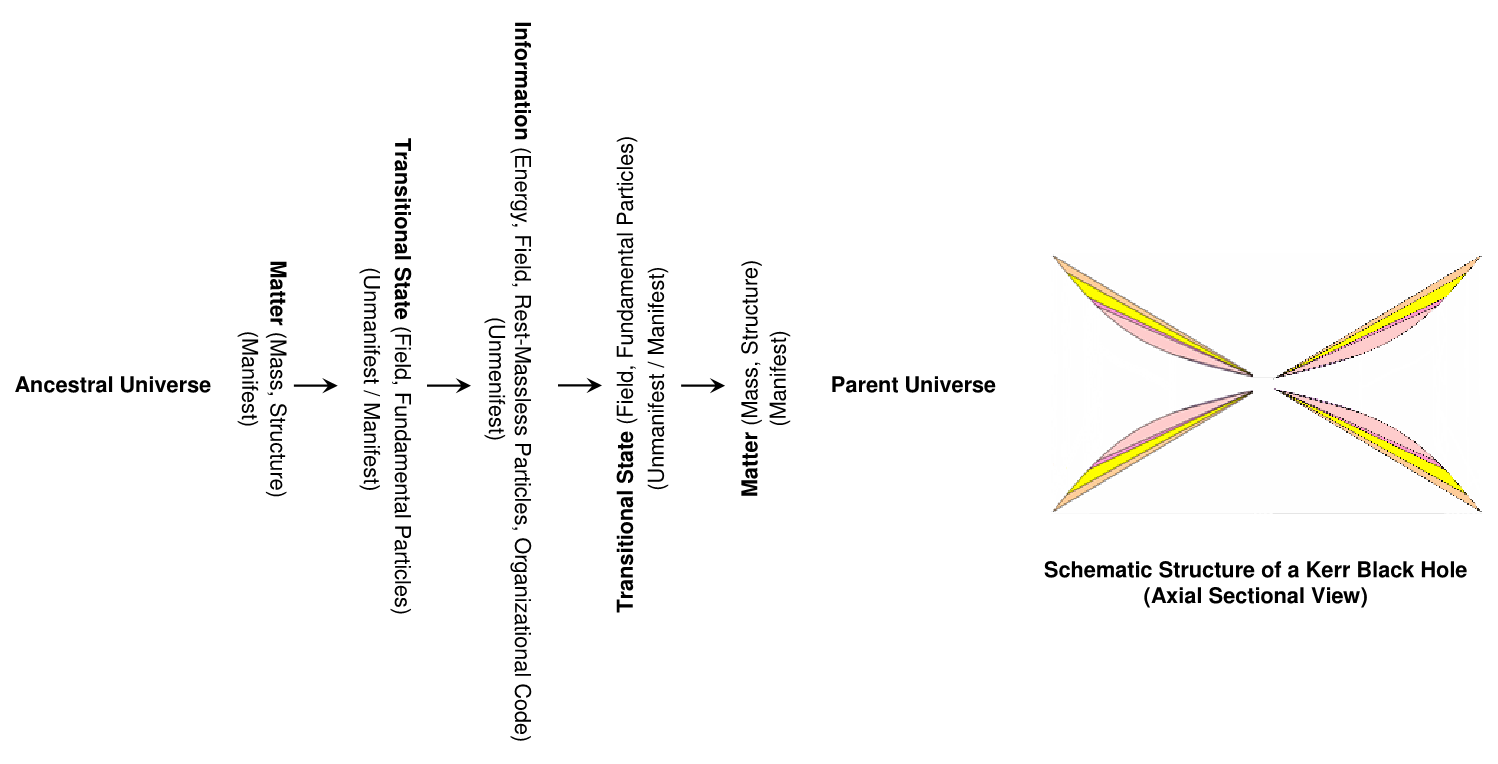
Figure 6 illustrates the process: matter of the ancestral universe is accreted by the parent black hole and turns from the explicate to the implicate order (packed into capsule packs with relations registered); after the burst, these packs are released on the other side of the throat and, through the transitional state, become manifest again as the matter and structure of the parent universe.
Trigger condition. By the existence criterion [3, 4], the lower limit of the difference of the areal radii of the two horizons is \(2\ell_p\): the two horizons register the irreducible part and the rotational part respectively, and when the separation falls below the lower limit the two registrations mix and can no longer be distinguished, and the structure breaks; the classical extremal point at which the two horizons coincide cannot be reached. Near the existence boundary, the absorption of one more rotational pack takes the separation below the lower limit in one step [4]. The spin of a black hole increases through accretion; the last rotational pack takes the black hole beyond the existence boundary, and the structure breaks and bursts, after which accretion may stop. This is the criterion of the present framework. In classical theory, the radiation torque of thin-disc accretion stops the spin at about 0.998 [56]; this cutoff comes from the accretion environment, not from spacetime itself; how a cosmic egg cell gets past it to reach the existence boundary is listed as an open question (Section 8.2).