Paper II [2] gave a known property of a flat universe: for the Hubble sphere of radius \(R_{\mathcal H}=c/H\) containing mass \(M_{\mathcal H}\),
It is only a scale defined by the expansion rate and has no physical binding power: it does not bind matter or stop light, matter and light can cross it in both directions, and the recession velocity on the Hubble sphere equals the speed of light. That it satisfies Eq. (22) means only that the Hubble sphere lies exactly at its own Schwarzschild radius; this is merely another way of writing the Friedmann equation of a flat universe and does not mean that the Hubble sphere is a black hole. The idea that the universe is the interior of a black hole is old [44, 45], and Smoller and Temple even regarded the Big Bang as a shock wave inside a black hole [46]; the difference here is that we count in \(E_c\) capsules, that after the burst the horizon converts into the Hubble sphere and retains the registered information, and that the dark-energy share accumulates gradually with the creation of background capsules. The horizon of the parent black hole had binding power before the burst; after the burst it converted into the Hubble-sphere horizon and the binding was removed. In terms of capsules, \(N_{\mathcal H}\approx4.25\times10^{60}\) [2]; all the capsules were released and unfolded into the parent universe.
Each generation of universe has its own Hubble sphere. Taking our parent generation as an example: when the parent black hole burst, the registrations on its inner and outer horizons transferred together to the Hubble sphere of the parent universe (i.e. our universe): the sum of the two horizon areas, \(A_++A_-=4\pi R_s^2=16\pi N_b^2\ell_p^2\) (Eq. (6)), converts into the area of the Hubble sphere. This is a conversion hypothesis proposed in this paper, the detailed process being left to future work. The initial radius and mean density of the Hubble sphere are
where \(N_b\) is the number of capsules of the critical state at the breaking point, \(N_b=N_{\mathrm{Pell}}+1\) in Paper IV [4], which corresponds to no existing black hole. Thereafter the Hubble sphere grows with the universe and always lies at its own Schwarzschild radius, which is why Eq. (22) holds at all times. The mean density \(\bar\rho_0\) does not mean that the released \(E_c\) packs start from this low density: the ratio of the volume enclosed by the horizon to the volume occupied by the \(N_b\) capsule packs themselves is
Each \(E_c\) pack has the constant density \(\rho_c\), and the horizon volume is \(N_b^2\) times the volume occupied by all the \(E_c\) packs; the mean density is the value spread over the whole horizon. The \(N_b\) packs released at the burst give the initial total amount of matter of the parent universe. If all the matter within today’s Hubble sphere came from this single release, \(N_b\) would be of order \(\Omega_mN_{\mathcal H}\approx0.315\times4.25\times10^{60}\approx1.3\times10^{60}\) (\(\Omega_m\) being the matter density parameter), with mass \(m_b=N_bm_P\approx2.9\times10^{52}\) kg, about \(2\times10^{11}\) times that of TON 618.
We map the parent black hole only onto the Hubble sphere, counting \(N_b\) only out to \(R_{\mathcal H}\); this is the account of one transfer, not a conservation relation. Most black holes in a universe stay in their own generation, and only very few reach the burst point. We make no inference about which generation the matter beyond the Hubble sphere comes from, and list the cross-generational energy balance as an open question.
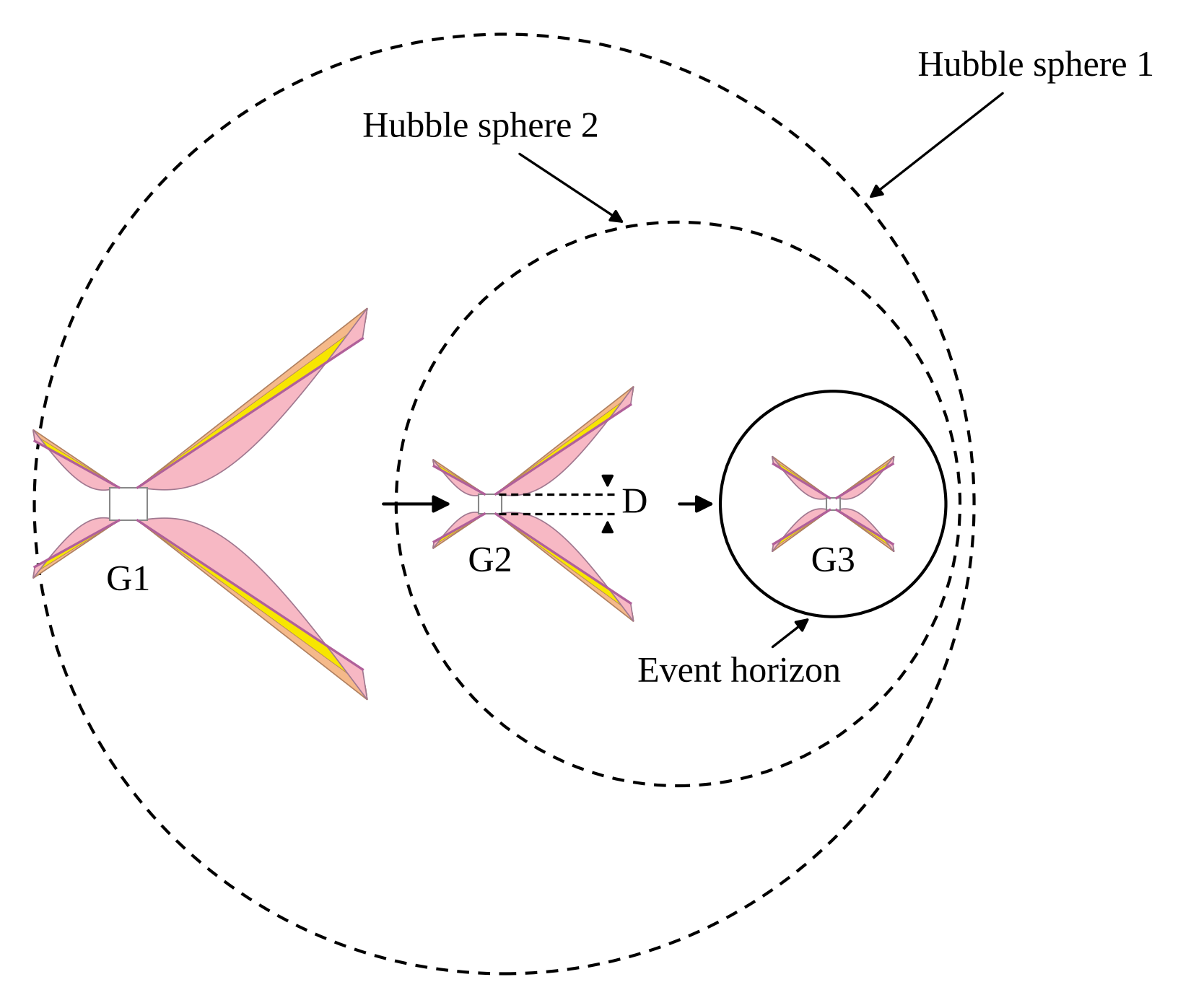
Multi-level nesting of universes and the common \(E_c\) background. Outside black holes there is always the background \(E_c\). This background may be shared by all generations of universes and has its own expansion rate. Hence the generations of universes coexist in a nested manner (Fig. 5): the horizon of each generation’s black hole is, as seen from the previous generation’s universe, a black hole, and after the burst it converts into the Hubble sphere of the universe of the same generation; black holes in the universe of the same generation in turn gestate the next generation. In Fig. 5, G1 is the ancestral universe and G2 the parent universe (i.e. our universe); both have burst, and their Hubble spheres are drawn dashed; G3 is a child black hole (such as TON 618), not yet burst, left–right symmetric, with its horizon drawn solid. All generations share the same \(E_c\) background, so any overlapping point has a single temperature, and there are no multiple background temperatures belonging to different generations. The common background and the inherited organizational code may provide an organizing mechanism for establishing a uniform initial thermal state in widely separated regions that were never causally connected; whether this removes the horizon problem of standard cosmology requires further study. Observation gives constraints that this hypothesis must satisfy: COBE/FIRAS found the CMB to be a precise blackbody spectrum, \(|y|<1.5\times10^{-5}\) (the Compton \(y\) parameter, which measures the deviation of the spectrum from a blackbody) [47]; if radiation at different temperatures were superposed at the same point, the mixed spectrum would deviate from a blackbody; and the CMB temperatures \(T\) measured at different redshifts \(z\) all follow \(T(z)=T_0(1+z)\) [48]. Temperature and the background clock are therefore shared by all generations and cannot be used to distinguish them; the generations differ in matter and organizational code. If the overlapping region contains matter from an earlier generation, it may appear as objects older than the local age of the universe, which is a testable direction.
After the burst, the parent black hole does not break into fragments like a burst balloon, but persists for a considerable time as the remnant of the parent black hole. Our universe is the unfolding on the other side of its throat, which also gives a physical meaning to the statement that “the ancestral universe did not perish immediately after the burst of the parent black hole, but continues to evolve alongside the parent universe”. Before the burst the black hole is at an extremely low temperature; after the burst the temperature of the remnant rises gradually towards the background temperature but always stays below it, appearing in the CMB Cold Spot as the low-temperature shadow of the remnant (Section 6.2). After the burst the Hubble sphere grows with the parent universe. The Hubble sphere, however, is not a black hole, and the Hawking temperature cannot be computed from its mass–energy.
The inherited number of matter capsules \(N_b\) is fixed, while the capsule number within the Hubble sphere, \(N_{\mathcal H}\), equals \(N_b\) only at the moment of the burst and thereafter changes with \(H\), \(N_{\mathcal H}=c/(2H\ell_p)\). The present relative rate of change of \(N_{\mathcal H}\) is about 3.2% per billion years: small, without change of order of magnitude, but not negligible. \(N_{\mathcal H}\) must be distinguished from two other counts. The Hubble sphere is not a fixed comoving volume, and the mass of matter in it also changes with time; the equivalent capsule number of the matter part is \(N_m=\Omega_mN_{\mathcal H}\); at the burst \(\Omega_m\approx1\) and \(N_m=N_{\mathcal H}=N_b\) (at the burst the inherited mass–energy consists entirely of capsule packs and the dark-energy residual is negligible relative to the total; “matter” here means the mass–energy of the inherited capsule packs, which differs in definition from \(\Omega_m\) in the Planck data of Section 5.1); the actual number of background capsules in the Hubble sphere is of order \(\phi N_{\mathcal H}^3\), contributing energy only through the residual, and it increases as the Hubble volume grows; this is the creation of background capsules with the expansion described in Paper II [2]. The three are different counts: \(N_b\) is the number of capsules inherited at the burst, \(N_{\mathcal H}\) the equivalent capsule number of the total mass–energy of the Hubble sphere, and \(\phi N_{\mathcal H}^3\) the actual number of background capsules.
The current cosmic timeline of standard cosmology: inflation (about \(10^{-36}\)–\(10^{-32}\) s) [49, 50, 51, 52] \(\to\) reheating and particle production \(\to\) electroweak phase transition (about \(10^{-12}\)–\(10^{-6}\) s; elementary particles acquire rest mass through the Higgs mechanism) \(\to\) Big Bang nucleosynthesis (about 10 s–20 min) \(\to\) matter–radiation equality (about 50 000 years) \(\to\) recombination and release of the CMB (about 380 000 years) \(\to\) dark ages \(\to\) reionization and Population III stars (about 100–500 million years). We are concerned with only two of these nodes: surviving primordial black holes begin to form once the local density falls below about \(2.9\times10^{56}\ \mathrm{kg/m^3}\) (Eq. (20)), far above the density of about \(10^{20}\)–\(10^{33}\ \mathrm{kg/m^3}\) at the electroweak phase transition; and Population III stars form in minihaloes rich in primordial black holes.