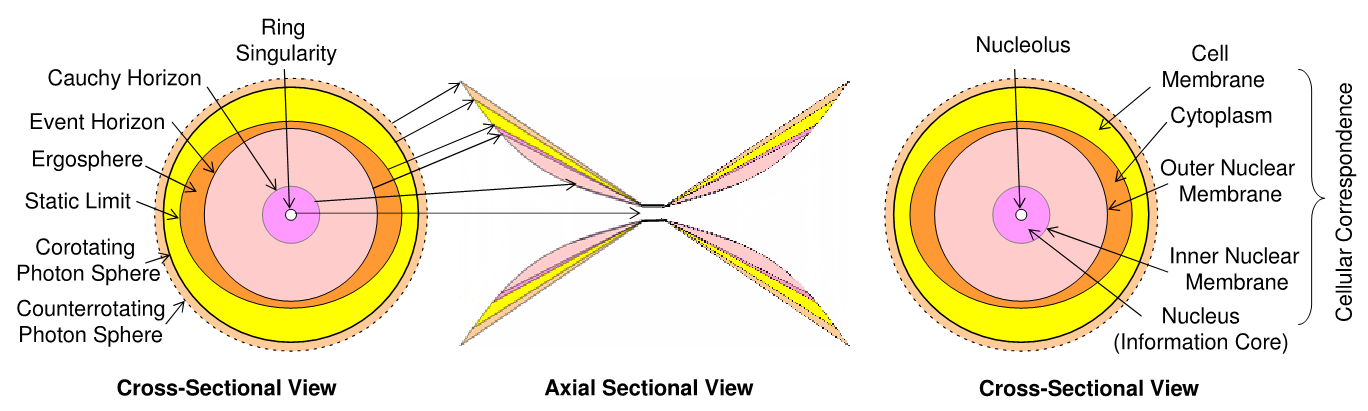
Under extreme gravitational conditions, a rotating Kerr black hole is also depicted in its spatial structure as a regular nested domain–boundary hierarchy, as shown on the left of Fig. 3. At the very centre is the ring singularity, isolated by the inner Cauchy horizon; in the middle is a region called the ergosphere, where, because of strong frame dragging, any matter entering is forced to co-rotate; it forms a special intermediate transition zone between the event horizon on the inside and the static limit on the outside; finally, the whole system connects on the outside through the photon sphere (for a Kerr black hole, strictly a photon region) to the asymptotically flat classical space of the universe.
This structure corresponds systematically to a eukaryotic cell in geometry and function (right of Fig. 3): the photon sphere corresponds to the cell membrane, the ergosphere to the cytoplasm, the event horizon to the outer nuclear membrane, the Cauchy horizon to the inner nuclear membrane, the interior to the nucleus, and the ring singularity to the nucleolus. The black hole is the basic “cell” unit of the universe; its unified organizational information divides into a bulk part and a surface part (Eq. (1)): the outer horizon registers its surface information \(\varPsi_s\) and the inner horizon its bulk information \(\varPsi_b\) (see Section 2.4):
The position of the inner nuclear membrane. Paper II [2] obtained the inner-interface radius \(\ell_p\) of a single capsule from the force balance of the spacetime interfacial tension. Generalizing to a black hole of energy \(E\): let the energy \(E\) be distributed uniformly as a massless field in a sphere of radius \(R\), with \(p=\rho/3=E/(4\pi R^3)\); cutting along the equatorial plane, the force pushing the two halves apart is \(F_{push}=p\cdot\pi R^2=E/(4R)\); the spacetime interfacial tension \(\tau=c^4/(8\pi G)\) gives a pull of \(\pi\tau\) at each of the inner and outer interfaces, \(F_{pull}=2\pi\tau=c^4/(4G)\) in all, independent of the radius [2]. Equating the two gives the inner-interface radius of the black hole,
In terms of the capsule number, \(R_i=N\ell_p\) and the outer interface is \(R_o=R_s=2N\ell_p\) (the horizon radius of a Schwarzschild black hole of the same mass), the ratio of the two being always 1:2. \(R_i\) depends only on the total energy, not on the spin, and is the boundary that confines the \(E_c\) capsule packs: in both Schwarzschild and Kerr black holes the capsule packs lie within \(R_i\); \(R_i\) itself stores no separate information, the information being registered on the horizons. A Schwarzschild black hole has no inner horizon, and the inner nuclear membrane corresponds to the inner interface \(R_i\); the inner nuclear membrane of a Kerr black hole is the Cauchy horizon (Section 2.4). The inner interface is a structure of the cell model of this paper.
What the nucleus contains. According to Paper III, the interior of a black hole consists of \(N\) capsules \(E_c\), and the entropy \(S/k_B=4\pi N^2\) is exactly the sum of the self terms of all capsules and their ordered pairwise relations, with no many-body terms; each pack is registered with the sequence number at which it entered, and the sequence number fixes its packing temperature \(k_BT_N^+=E_P/[4\pi(2N+1)]\) and characteristic wavelength; unpacking follows the last-in-first-out rule [3]. The “organizational code” of a black hole is this set of relations registered in order: it records the whole history of the black hole, which is the counterpart of the cell nucleus as the repository of genetic information. Paper II [2] pointed out that the capsule energy density \(\rho_c\) is the upper limit of actual physical density, so there is no singular point of infinite density inside a black hole; in the present framework the ring singularity in Fig. 3 corresponds to the position of the innermost nucleolar structure in the nucleus.
From the outside in, a black hole therefore shows a gradient from manifest to hidden: outside the horizon are unpacked matter and radiation (explicate order), inside the horizon are the packed \(E_c\) and their relations (implicate order); the conversion between the two is packing and unpacking, taking place at the inner interface \(R_i\), with the relations registered on the horizons [3].