Paper I [1] gave the full definition of the domain–boundary framework: every organizational domain has both a bulk state and a surface state, and the unified organizational information is
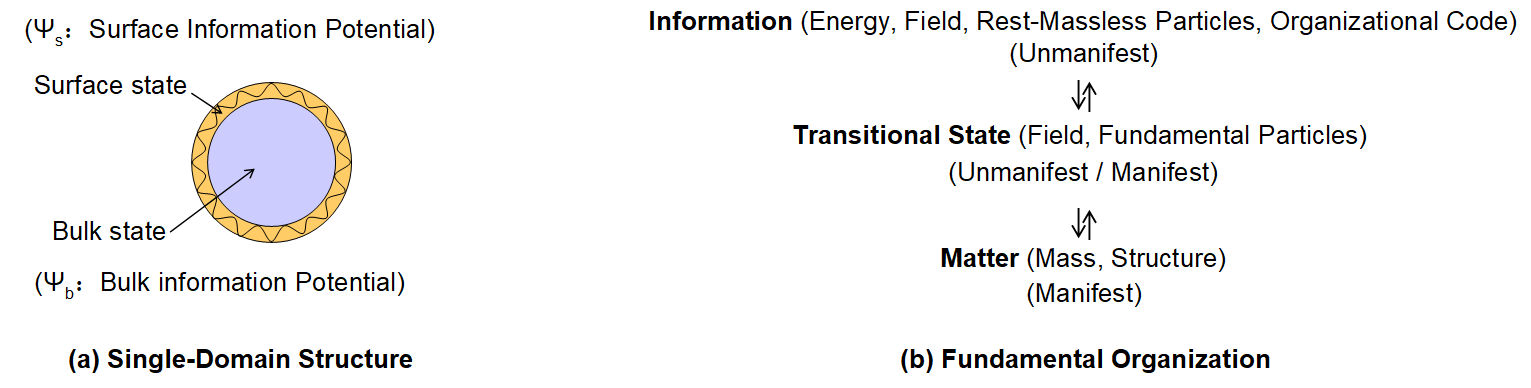
As shown in Fig. 1(a), the bulk information potential \(\varPsi_b\) is responsible for the storage, inheritance and historical memory of information, and the surface information potential \(\varPsi_s\) for recognition, exchange, coupling and the formation of new organization; when two organizational domains remain coupled, the nonlinear action of the surface information potentials forms a new coupling interface, which can grow further into a new organizational domain, so that the formation of organization is a continuous recursive process [1]. This division of labour presupposes that the bulk has structure. The cell nucleus contains complex structures such as chromatin made of DNA and histones, and information can be stored in the bulk. When the bulk loses the structures that can carry information, for example when matter is compressed into a black hole and only rest-massless energy packs (\(E_c\)) remain, the storage of information can only move to the surface, and the upper limit of organizational information is set by the surface area; this is the content of the holographic principle for black holes [5, 6, 7, 8]. The black hole is the limit of this situation (see Section 2.4).
Paper I divided every organizational domain into manifest matter (mass and structure) and unmanifest information (energy and organizational code) [1]. To treat celestial scales, we add fields and rest-massless particles to unmanifest information and introduce between the two a transitional state: fields and elementary particles, which may include some massless particles. Manifest matter and unmanifest information convert into each other through the transitional state (Fig. 1(b)). When information corresponds to a particular organizational domain, it is called unified organizational information.
Information and matter are related quantitatively. For a bounded system of radius \(R\) and energy \(E\), the amount of information (in bits) does not exceed \(2\pi RE/(\hbar c\ln2)\) [21]; a black hole attains this upper limit. Setting \(E=Mc^2\) and \(R=R_s=2GM/c^2\) gives
i.e. at a given scale a black hole carries the largest amount of information. The amount of information grows as the square of the mass \(M\).