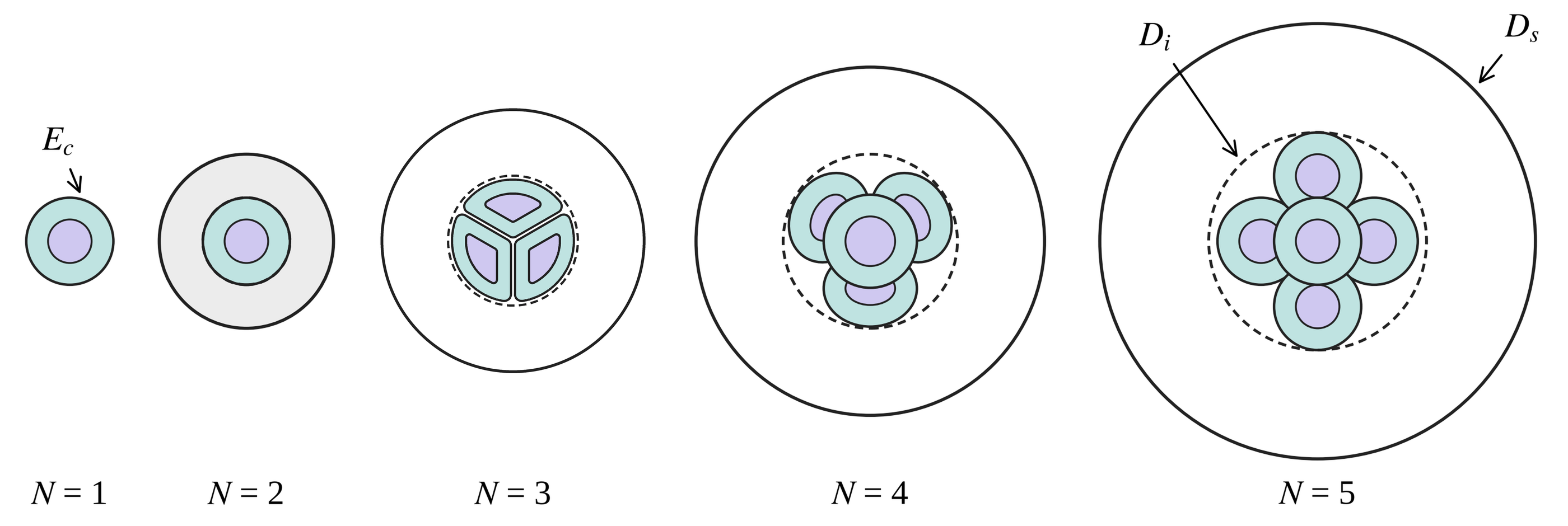
When \(N\) spherical capsules are packed into a ball of radius \(R_i\), their centres must lie within a ball of radius \((N-2)\ell_p\), and any two centres must be at least \(4\ell_p\) apart. After deformation the capsules depart from spherical shape and the shell thickness cannot be kept at \(\ell_p\) everywhere, so these placements are all metastable. Under volume-preserving deformation the number of capsules that fit inside \(R_i\) is \(\lfloor V(R_i)/V_o\rfloor=\lfloor N^3/8\rfloor\): for \(N=2\) only one fits, and for \(N\ge3\) all \(N\) capsules fit. The placements for \(N=1\)–5 are shown in Fig. 1.
\(N=2\): only one spherical capsule fits inside. The ball of radius \(R_i=2\ell_p\) has volume \(\frac43\pi(2\ell_p)^3=\frac{32}{3}\pi\ell_p^3\), exactly the volume of one capsule. One capsule fills \(R_i\) and can only be spherical; the second capsule has nowhere to go, and its energy \(E_P\), not formed into a pack, is distributed between \(R_i\) and the horizon.
\(N=3\): three deformed capsules fit inside. If the three capsules stayed spherical, their centres would have to lie within a ball of radius \(R_i-2\ell_p=\ell_p\), so no two centres could be more than \(2\ell_p<4\ell_p\) apart; they do not fit, and must deform. Three half-planes through a common diameter, \(120^\circ\) apart, divide the ball of radius \(R_i=3\ell_p\) into three \(120^\circ\) wedges, each of volume \(12\pi\ell_p^3\), larger than the capsule volume \(32\pi\ell_p^3/3\); each capsule deforms and is placed in one wedge, shown in projection along the threefold axis.
\(N=4\): four deformed capsules fit inside after deformation. Dividing the ball of radius \(R_i=4\ell_p\) into four parts with regular-tetrahedral symmetry, one deformed capsule can be placed in each part, so all four deformed capsules fit; the figure shows the projection along a threefold axis. If the four capsules all remained spherical, their centres would have to lie within a radius \(2\ell_p\), whereas a minimum centre separation of \(4\ell_p\) requires a circumradius of at least that of the regular tetrahedron, \(\sqrt6\,\ell_p\approx2.45\ell_p\); so spherical capsules do not fit, and they must deform.
\(N\ge5\): all \(N\) spherical capsules fit. The arrangement for \(N=5\) is given below. For \(N\ge6\), place the \(N\) centres equally spaced on a circle of radius \((N-2)\ell_p\); adjacent centres are \(d_N=2(N-2)\sin(\pi/N)\,\ell_p\) apart. For \(N=6\), \(d_6=2\cdot4\cdot\sin(\pi/6)\,\ell_p=4\ell_p\), so adjacent capsules just touch; and \(d_N=2\pi(1-2/N)\,[\sin(\pi/N)/(\pi/N)]\,\ell_p\). Here \(1-2/N\) increases with \(N\); \(\sin x/x\) decreases monotonically on \(0<x\le\pi/2\), and \(x=\pi/N\) decreases as \(N\) grows, so \(\sin(\pi/N)/(\pi/N)\) also increases with \(N\) (tending to 1). Both factors increase with \(N\), so \(d_N\) increases with \(N\), and for \(N\ge6\), \(d_N\ge d_6=4\ell_p\): all \(N\) spherical capsules fit. For \(N=5\), \(d_5\approx3.53\ell_p<4\ell_p\) and the circle does not suffice; the triangular bipyramid below is needed. \(N=5\) is the smallest black hole in which all capsules fit inside \(R_i\) in spherical form. The five spherical capsules are arranged as a triangular bipyramid, shown in side projection. Two centres lie at the poles and three on the equator, \(120^\circ\) apart, all on a sphere of radius \(r=2\sqrt2\,\ell_p\approx2.83\ell_p\): a pole and an equatorial centre are \(\sqrt2\,r=4\ell_p\) apart, and equatorial centres are \(\sqrt3\,r\approx4.90\ell_p\) apart, none less than \(4\ell_p\); since \(r<3\ell_p\), all five spherical capsules lie inside \(R_i\).