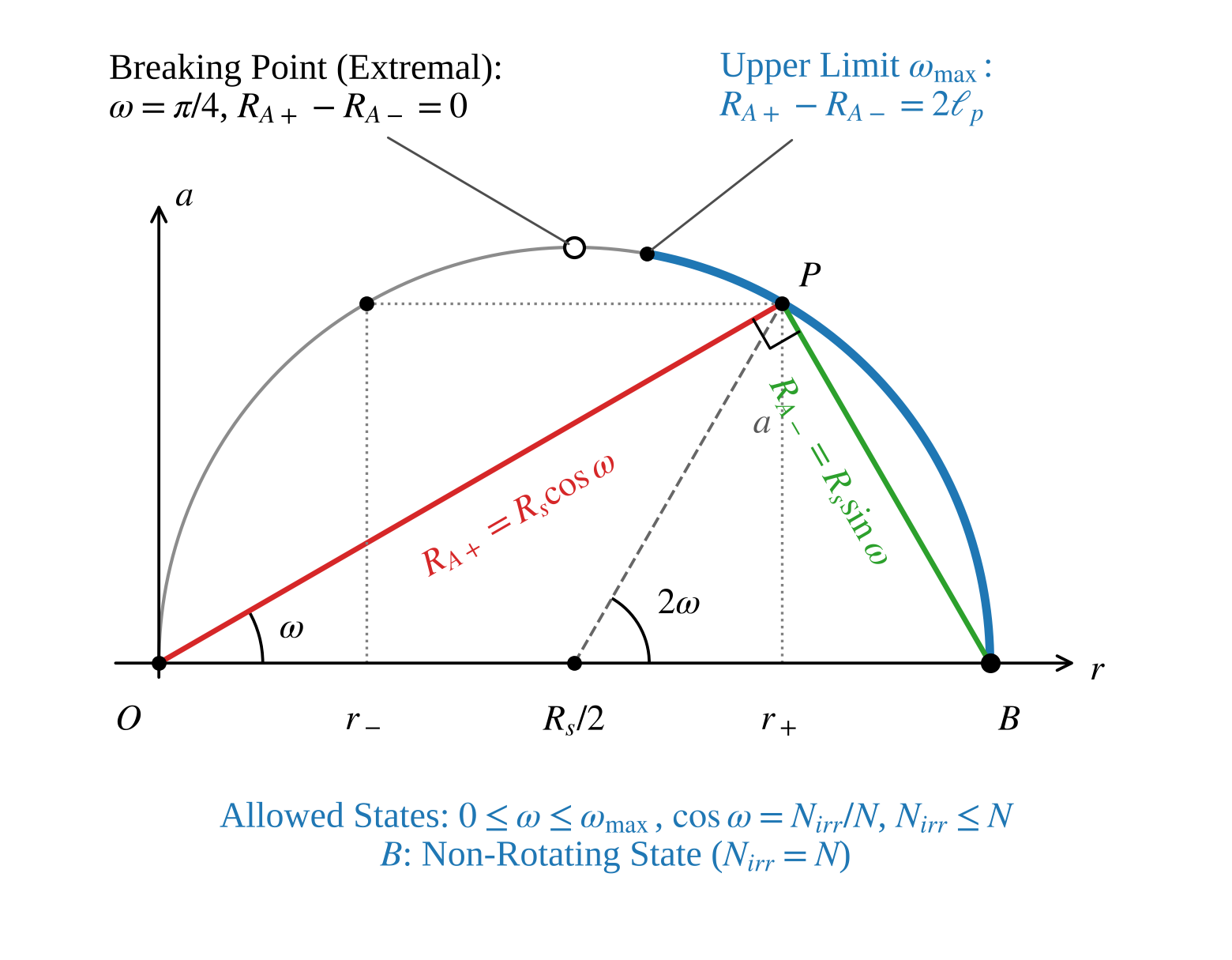
We first write Eq. (80) in terms of capsule numbers. Write \(\mathcal{J}\equiv J/\hbar\), with \(N=Mc^2/E_P\) as in Eq. (86). Multiplying both sides of Eq. (80) by \(c^4/E_P^2\) and using \(E_P^2=\hbar c^5/G\):
so that
The distribution over the two horizons can be expressed by a single angle. Let \(N_{irr}=N\cos\omega\); then \(\sqrt{N^2-N_{irr}^2}=N\sin\omega\). By Eq. (87), using \(R_s=2N\ell_p\) and \(r_+=(GM/c^2)\big(1+\sqrt{1-\chi^2}\big)=N\ell_p\big(1+\sqrt{1-\chi^2}\big)\),
Comparing with \(N_{irr}^2=N^2\cos^2\omega\) gives \(\cos^2\omega=\big(1+\sqrt{1-\chi^2}\big)/2\), and by the double-angle formula
i.e. \(2\omega\) is the spin angle, \(0\le\omega\le\pi/4\). By Eq. (94),
in agreement with general relativity: \(\mathcal{J}=J/\hbar=aMc/\hbar=\chi GM^2/(\hbar c)=\chi M^2/m_P^2=\chi N^2\). Now consider the two horizons. By Eq. (81), \(r_\pm=GM/c^2\pm\sqrt{(GM/c^2)^2-a^2}\); using \(a=\chi GM/c^2\) gives \(r_\pm=GM/c^2\pm\sqrt{(GM/c^2)^2-\chi^2(GM/c^2)^2}=(GM/c^2)\big(1\pm\sqrt{1-\chi^2}\big)\), and by Eq. (96), \(\sqrt{1-\chi^2}=\cos2\omega\); with \(GM/c^2=R_s/2\), \(r_\pm=(R_s/2)(1\pm\cos2\omega)\). Substituting into Eq. (84) and comparing with Eqs. (88) and (89),
The areal radii of the two horizons are exactly the two legs of a right triangle with hypotenuse \(R_s\): by Eq. (91), the three radii satisfy the Pythagorean theorem \(R_{A+}^2+R_{A-}^2=R_s^2\), and the entropy sum of Eq. (90) is \(\cos^2\omega+\sin^2\omega=1\). This triangle has a direct geometric origin: the horizon condition \(\Delta=0\) can be written as \((r-R_s/2)^2+a^2=(R_s/2)^2\), which in the \((r,a)\) plane is a circle of radius \(R_s/2\) and diameter \(R_s\); the point \(P(r_+,a)\) lies on the circle, and by Thales’ theorem the angle subtended at \(P\) by the diameter \(OB\) is a right angle, the angle at \(O\) is \(\omega\), and the central angle of \(P\) is \(2\omega\) (Fig. 3). Since \(\cos\omega=M_{irr}/M\), Eq. (95) is the geometric form of Christodoulou’s irreducible-mass relation [34]. Without rotation, \(\omega=0\) and \(R_{A-}=0\); in the extremal case, \(\omega=\pi/4\) and \(R_{A+}=R_{A-}=R_s/\sqrt2\), in agreement with Section 8.1.
Writing the fraction of rotational capsules as \(x\equiv N_{rot}/N=1-\cos\omega\), Eq. (98) gives \(S_+/S_{tot}=\cos^2\omega=(1-x)^2\) and \(S_-/S_{tot}=\sin^2\omega=1-(1-x)^2=x(2-x)\), the same form as the Page curve, Eqs. (62) and (63): the rotational capsule number \(N_{rot}\) corresponds to the packs that can be unpacked, the outer horizon to the black-hole interior, and the inner horizon to the radiation. In the extremal case \(S_+=S_-\): the entropies of the two horizons balance. With \(S_+/S_{tot}=\cos^2\omega=(1-x)^2\) and \(S_-/S_{tot}=\sin^2\omega=x(2-x)\), the condition \(S_+=S_-\) gives
Expanding and collecting terms, \(1-2x+x^2=2x-x^2\), that is \(2x^2-4x+1=0\), with roots \(x=1\pm\frac{1}{\sqrt2}\). Since \(0\le x\le1\), only the root \(x=1-\frac{1}{\sqrt2}\) is physical, and
This balance point has the same value as the information Page point \(x_P\) of Eq. (66). The maximum extractable rotational energy of 29.3% stated in Section 8.1 is exactly this balance point: the extractable rotational energy can at most equalize the entropies of the two horizons, and the outer horizon always carries more than half of the entropy. By the existence criterion of Section 8.4, the extremal state is not an allowed integer state, so 29.3% is an upper bound in the continuum limit, not reached by black holes of finite \(N\).