It should be noted that germline sequestration and transgenerational germline pre-setting, discussed in this section and in Sections 4.10–4.12, represent one evolutionary pathway among several by which complex animals achieve biological holography — a pathway found primarily among bilaterian animals with highly differentiated organ systems that reproduce via oviparity, viviparity, or ovoviviparity. Other pathways are discussed together in Section 5.5.
Complex multicellular organisms exhibit not only the continual expansion of organization across spatial scale, but also informational continuity across generations. The preceding sections addressed the spatial organizational process by which the complete cell (SS0) continually recurs and recurses to form higher-level organizational structure (SSi); the capacity of life to continue evolving over the long term, however, depends on another continuously maintained informational thread — the germline.
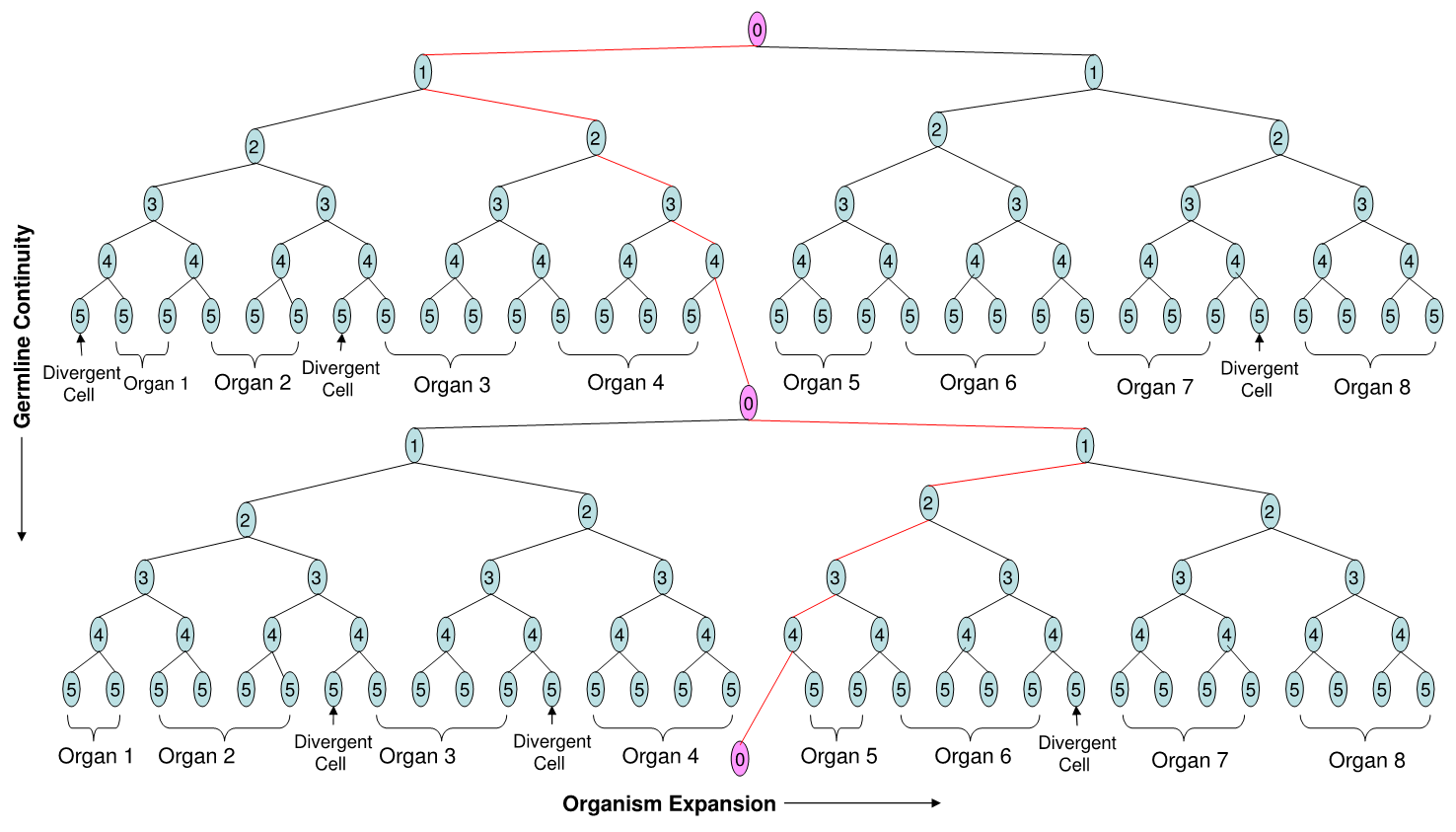
Fig. 14 illustrates the unified organizational pattern of multicellular organisms along two dimensions: spatial organization and temporal continuity. The black branches in the figure represent the process by which the fertilized egg undergoes continual cell division, tissue differentiation, and individual development to gradually form a complete organism — the process of organism expansion. The red continuous lineage, on the other hand, represents the sustained transmission of germ cells across generations — germline continuity. These two principal threads correspond, respectively, to the spatial expansion and temporal continuation of living organization, together maintaining the long-term stability of the living system.
In Fig. 14, the fertilized egg corresponds to the initial recursive organizational unit of the individual, Initial SS0, constituting Level 0 of the entire continuous cell recursive lineage. Thereafter, every cell can be traced, through the continuous recursive lineage, back to this common origin.
Fig. 14 Germline continuity in multicellular organisms
Notably, although every individual of every generation eventually ages and dies, a continuous germ-cell lineage is preserved throughout. Every offspring egg cell can be traced back to the egg cell of its mother, grandmother, great-grandmother, and still earlier ancestral germ cells. This continuous lineage is not maintained by the individual as a whole, but perpetuated by the germline itself. From the standpoint of biological evolution, therefore, a new life is not a fresh start of genetic information, but simply a new node on this continuous reproductive lineage.
At the same time, once each generation’s fertilized egg forms, it goes on to form new tissues, organs, and a complete individual through continuous cell division. Spatial organization thus continually expands, while temporal information remains continuously unbroken. Living individuals are continually renewed, yet the living system itself remains continuous throughout — an important reason why life has been able to continue evolving for billions of years.
From the standpoint of the Unified Recursive Organization Theory, every fertilized egg can be regarded as an Initial SS0. Once formed, it continually forms higher-level recursive organizational units (SSi) through structural recurrence and structural recursion, ultimately establishing the complete organism. Once life completes reproduction, however, a new Initial SS0 is again generated, entering the next round of organizational recursion. Multicellular life is therefore not a one-time act of organizational construction, but a continuous process cycling through SS0 → SSi → SS0 → SSi.
This cycle has two salient features. First, living organization continually expands toward higher levels, achieving individual development (expansion). Second, the germline remains continuously unbroken across generations, allowing life’s information to be preserved over the long term (continuity). At the same time, throughout each generation, large numbers of somatic cells are continually renewed, age, and undergo apoptosis, while only a very small number of cells enter the germline of the next generation — a selective process of retention and renewal that embodies the asymmetric renewal of living organization.
Living systems can therefore be summarized in terms of three interrelated and complementary basic organizational principles:
Expansion — continually forming higher-level tissues, organs, and the complete individual through structural recurrence and structural recursion, achieving the sustained growth and increasing complexity of living organization.
Continuity — maintaining the continuity of life’s information through the transgenerational transmission of the germline.
Asymmetric renewal — not all cells within living organization share the same fate; the recursive process continually generates divergent cells with different fates. Most somatic cells undertake tissue formation, functional execution, and the maintenance of the individual, ultimately undergoing senescence, apoptosis, or programmed elimination; only a very small number of cells enter the germline, bearing the task of transmitting life’s information continuously across generations. This asymmetric retention together with asymmetric elimination constitutes the basic mechanism of life’s continual renewal.
It should be noted that asymmetric renewal is not a strategy exclusive to complex multicellular organisms, but an organizational principle of general significance. In both unicellular and multicellular organisms, cell division is the shared underlying mechanism through which organizational renewal and informational transmission are achieved; asymmetric renewal is simply the organizational expression of this shared mechanism, holding equally in unicellular and multicellular organisms alike — the division of unicellular organisms follows the same principle, differing only in what is asymmetrically partitioned, which varies according to the type of organism
Oogenesis is a representative example of asymmetric renewal. Through two successive meiotic divisions, a single primary oocyte ultimately gives rise to one mature ovum and three polar bodies. Although all four cells derive from the same initial oocyte (Initial SS0), only the mature ovum retains the great majority of the cytoplasm and organizational resources required for development, continuing on into the germline of the next generation, while the three polar bodies fail to obtain the organizational conditions required for continued recursive organization; their life cycle terminates rapidly, and they exit the continuous recursive lineage. Life does not retain all products of division equally, but achieves the continuous inheritance of organizational information through selective retention, while achieving optimal allocation of resources through selective elimination.
Similar instances of asymmetric renewal are widespread across every level of life. During embryonic development, for example, large numbers of transient cells undergo programmed apoptosis; the immune system continually generates and eliminates large numbers of immune cells; intestinal epithelial and skin cells are continually renewed; and the nervous system retains certain cells over the long term while continually renewing its supporting cells. Living organization exists perpetually in a dynamic equilibrium of “partial retention, partial renewal,” rather than having all its components renew in synchrony.
Asymmetric renewal is therefore not an isolated developmental phenomenon, but an organizational principle followed universally by living organization. Without selective retention, transgenerational continuity could not form; without selective renewal, new organizational function and adaptive evolution could not arise. Asymmetric renewal is thus an indispensable basic mechanism for the continued evolution of life.