Although complex multicellular organisms ultimately form highly differentiated tissues, organs, and organ systems, their vital activity almost always begins with a single complete fertilized egg. In both animals and plants, the earliest stage of development involves a single cell undergoing continual division, growth, and differentiation, ultimately forming the complete individual. From the standpoint of the Unified Recursive Organization Theory, complex life therefore does not alter the basic regularity of living organizational formation, but instead continually forms higher-level organizational structure through sustained structural recurrence and structural recursion, building on the complete recursive organizational unit (SS0).
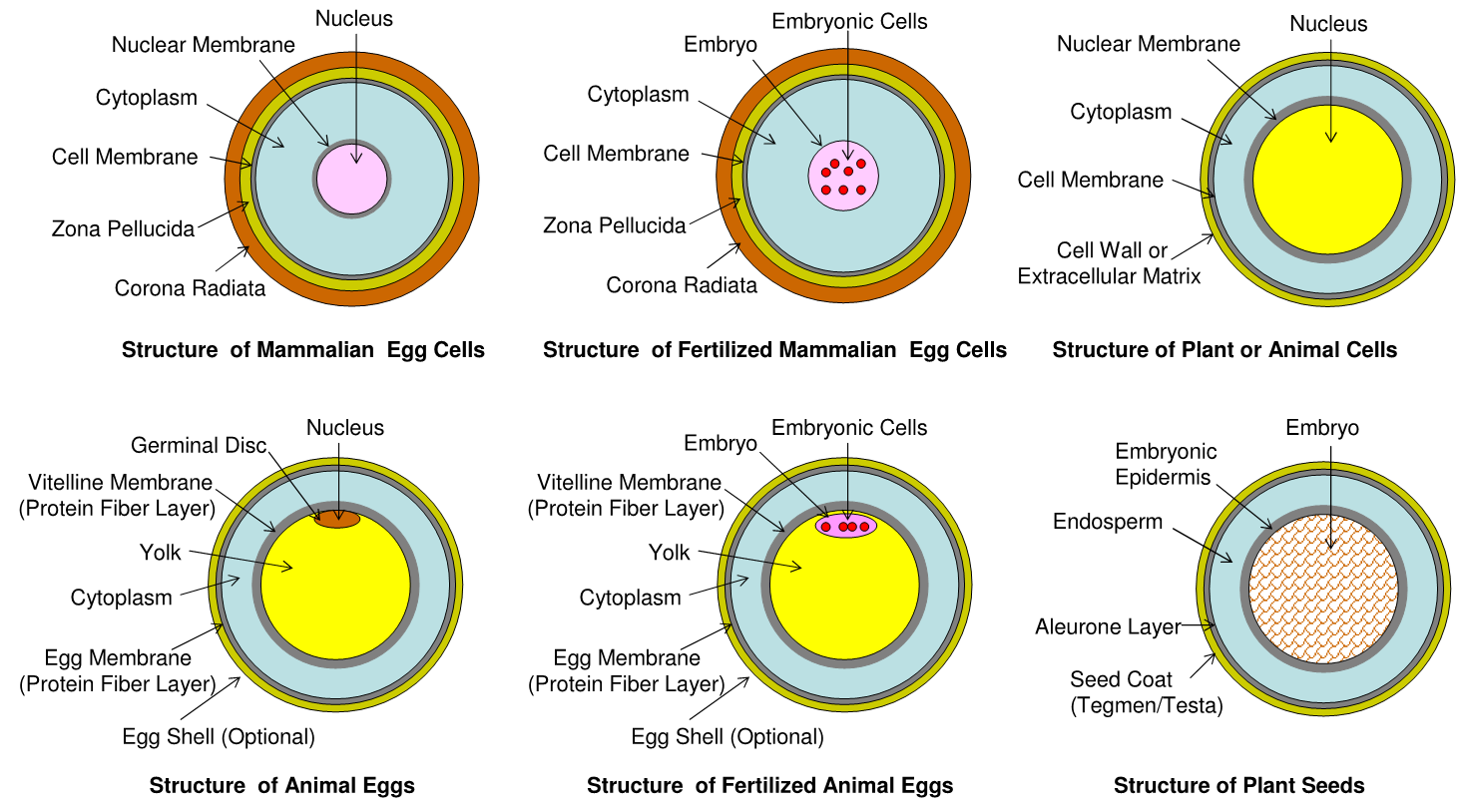
Fig. 13 presents six representative double-domain organizational structures found in complex multicellular organisms: the mammalian egg cell, the fertilized mammalian egg, an ordinary animal cell, the egg of an oviparous animal, its fertilized form, and the plant seed. Although these differ markedly in outer boundary, nutrient source, and mode of development, they can each be resolved into the same basic organizational unit — a Cell or Embryo constituting the living subject, jointly enclosed by peripheral supporting tissue that forms a complete developmental system. The mammalian egg cell, for example, is surrounded by protective structures such as the zona pellucida and corona radiata; birds and other oviparous animals form an egg membrane, yolk, and, in some species, an eggshell; and plant seeds further form peripheral tissues such as the endosperm, aleurone layer, and seed coat — together constituting the organizational boundary of these different types of living organism.
Fig. 13 Double-domain structure: Cells or eggs of complex multicellular organisms
Oviparous animals are widely distributed across different evolutionary lineages of the animal kingdom, including marine invertebrates, insects, fish, amphibians, reptiles, and birds. The scale of their eggs varies enormously, from microscopic insect and fish eggs to chicken, goose, and ostrich eggs, and even the fossilized eggs of extinct dinosaurs, yet all follow the same basic organizational pattern: the embryo as the living subject, surrounded by the yolk, which supplies nutrition, and protected mechanically by the egg membrane and, in some species, the eggshell. This organizational consistency, spanning vastly different animal groups and an enormous range of scales, shows that living organization follows a highly conserved basic organizational regularity.
Mammals adopt a different mode of development. Because the embryo develops within the maternal uterus and continually obtains oxygen and nutrients through the placenta, the mature egg cell no longer stores substantial yolk, retaining only protective structures such as the zona pellucida and corona radiata. In other words, mammals have not lost the yolk domain, but have transferred its primary nutritive function to the maternal placental system — effectively “outsourcing” the nutritional system. Animal embryonic development is therefore, in general, an open embryo strategy, in which vital activity remains continuously coupled to an external nutritional environment.
Plants have developed another representative organizational strategy. Once mature, a plant seed must separate from the parent, undergo prolonged dormancy, and germinate anew under suitable conditions. Plants therefore not only form a complete embryo, but also establish an encapsulating system — nutrition supplied by the endosperm, germination regulated by the aleurone layer, and environmental protection provided by the seed coat — enabling the embryo to withstand drought, cold, and other environmental stresses. This mode of organization can be regarded as an encapsulated embryo strategy, in sharp contrast to the open embryo strategy of animals.
Although plants and animals adopt different developmental strategies, both follow the same organizational regularity: life first forms a complete cell (SS0), then continually forms higher-level living organization through continuous cell division, cell differentiation, and organizational recursion. As recursion proceeds, what is newly added is not a new basic cell type, but continually new organizational relationships between cells, giving rise to new organizational function, new informational organization, and new levels of life.
From the standpoint of the Unified Recursive Organization Theory, the developmental process of a complex multicellular organism is therefore essentially a continuous process in which the complete recursive organizational unit (SS0) undergoes continual recurrence and recursion to form higher-level recursive organizational units SSi (i ≥ 1). Whatever the resulting organism — plant or animal — the increase in its organizational complexity arises mainly from the sustained establishment of organizational relationships, rather than from continual changes in the basic structure of individual cells.
Complex multicellular organisms thus constitute the most direct and complete validation of the Unified Recursive Organization Theory. Beginning with the fertilized egg, structure, function, and information remain in coordinated recurrence and coordinated recursion throughout, continually forming new organizational levels and ultimately establishing a complete organism with highly differentiated tissues, organs, and organ systems. This process demonstrates clearly that the source of biological complexity is not any single cell becoming progressively more complex, but the continual formation of new organizational relationships among multiple complete recursive organizational units (SS0), further recursing to form higher-level organizational units SSi (i ≥ 1).