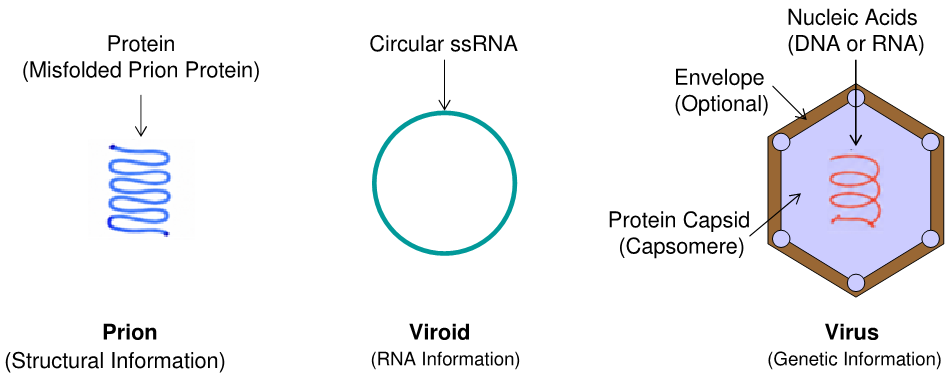
Non-cellular biological systems include prions, viroids, and viruses as illustrated in Fig. 10. All lack a complete cellular structure and an independent metabolic system, and cannot replicate autonomously apart from a host; whether they qualify as true living entities therefore remains debated. From the standpoint of informational organization, however, they represent an important stage in the gradual evolution of structural information into genetic information.
Prions possess neither DNA nor RNA and consist solely of misfolded protein, constituting a unit of structural information encoded by protein conformation. A prion can induce the same conformational change in a host’s normal protein, allowing structural information to propagate and recur continually among different protein molecules. Much as an existing lattice guides the formation of new lattice during crystal growth, a prion directs the folding of new protein molecules through its existing conformation, showing that structural information can not only be preserved but also propagate across hosts. This demonstrates that the preservation and propagation of information need not depend on DNA or RNA; structure itself can equally serve as an information carrier.
Fig. 10 Representative non-cellular biological systems illustrating the evolution of information carriers
Viroids consist solely of a circular single-stranded RNA molecule, lack a protein coat and any complete cellular structure, and must rely on a host cell to replicate. Compared with prions, the information carried by a viroid is no longer attached to protein conformation but is jointly preserved by its RNA sequence and spatial structure. This marks the beginning of a transition from information as a structural state to information as nucleic acid encoding, providing a more stable information carrier for the eventual formation of genetic information.
Viruses further develop an organizational form of information composed of DNA or RNA together with a protein capsid. Genetic information is preserved in the nucleic acid, while the protein capsid protects and delivers this genetic information, relying on the host cell to accomplish replication, expression, and assembly. Although a virus still cannot metabolize independently, it has already formed a relatively complete informational organizational system, with organizational complexity and informational expression capacity markedly exceeding those of prions and viroids.
Prions, viroids, and viruses are therefore not three mutually isolated classes of biological entity, but successive stages in the continual development of informational organization. From the protein-conformational information of prions, to the RNA information of viroids, to the DNA/RNA genetic information of viruses, the mode of information preservation progressively develops from structural information into sequence information, with the stability, replicative capacity, and transmissibility of information continually increasing. This continuous evolutionary progression shows that the evolution of life reflects not only the increasing complexity of organizational structure, but also the continual development of the capacity to preserve, replicate, and transmit information.
They are best understood as surviving “information fossils,” recording how structural information gradually evolved into genetic information and further developed boundaries, organization, and increasingly complex informational organizational systems — offering important clues to the formation of complete cellular life.